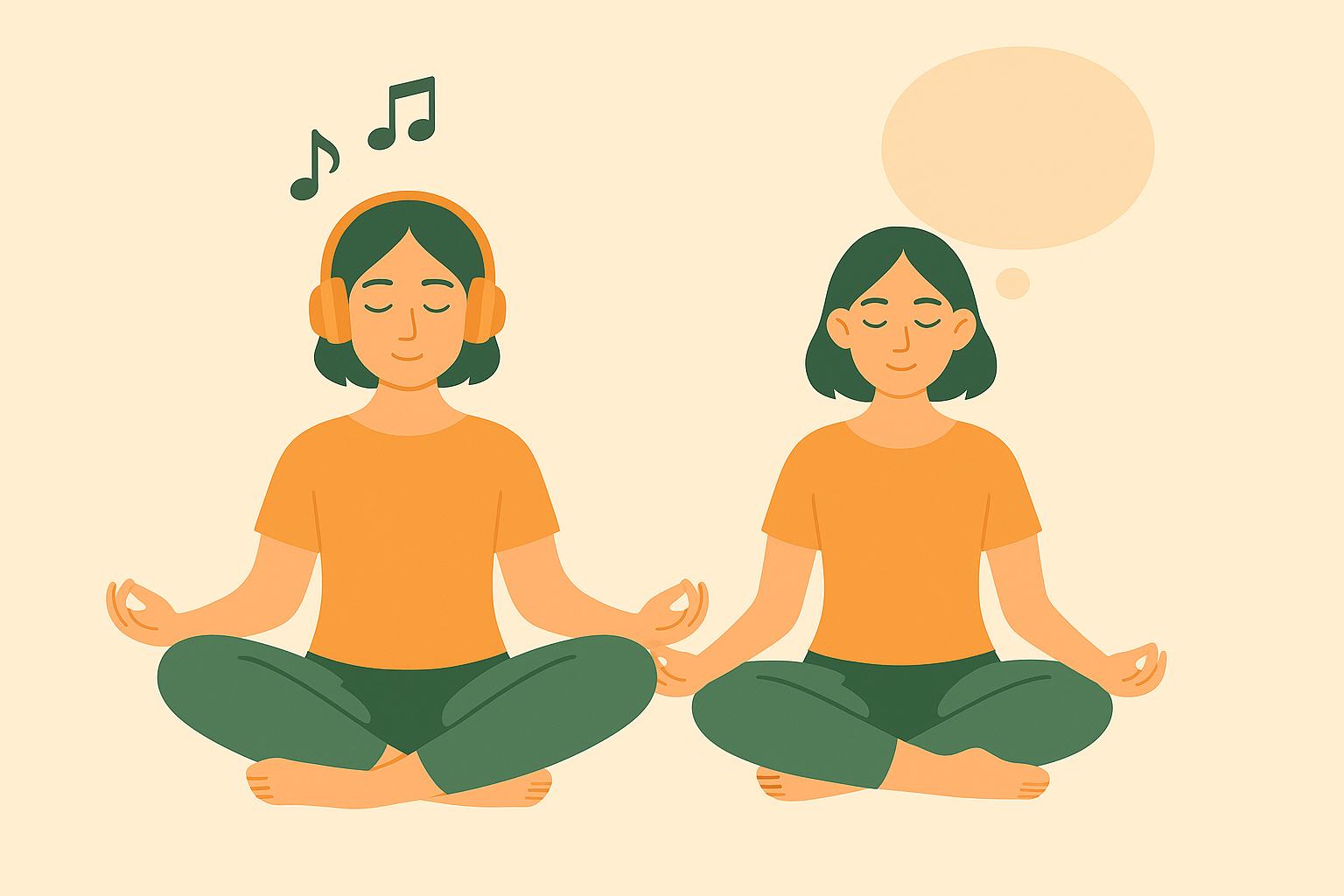
Meditation has become one of the most widely studied tools for improving mental clarity, emotional balance, and stress resilience. But one question continues to divide beginners and experienced practitioners alike: is guided meditation better than silent meditation? Research from Harvard Medical School, the American Psychological Association, the National Institutes of Health, and Stanford University suggests that both styles are effective—but in different ways and for different people.
Rather than asking which meditation is universally better, a more useful question is: which type of meditation best supports your current mental state, lifestyle, and goals? Understanding the science behind guided and silent meditation can help you choose the practice that truly fits your needs.
If you’re new to meditation, you may also find this helpful:
What Is Mindfulness and How to Start?
What Is Guided Meditation?
Guided meditation involves following spoken instructions from a teacher, recording, or app. The guide leads your attention through breathing, body awareness, visualization, or emotional focus.
Guided meditation commonly includes:
- verbal cues for breathing
- body scan instructions
- visual imagery
- affirmations or intention setting
- gentle reminders to refocus
According to NIH research, guided meditation is especially helpful for beginners because it reduces mental wandering and provides structure during early practice.
What Is Silent Meditation?
Silent meditation is practiced without external guidance. You sit quietly and direct your attention internally—often toward the breath, bodily sensations, or open awareness.
Silent meditation may include:
- breath-focused attention
- open monitoring of thoughts
- mantra repetition (internally)
- body awareness without narration
Harvard research shows that silent meditation strengthens self-regulation and awareness by encouraging the brain to manage distractions independently.
The Brain Science Behind Meditation
Both guided and silent meditation activate similar brain regions, particularly the prefrontal cortex, anterior cingulate cortex, and insula—areas involved in attention, emotional regulation, and self-awareness.
Stanford neuroscience studies demonstrate that consistent meditation practice reduces activity in the brain’s default mode network (DMN), which is responsible for rumination, overthinking, and mental noise.
However, the way the brain engages differs slightly depending on the meditation style.
How Guided Meditation Affects the Brain
Guided meditation provides external cognitive support. The voice acts as an anchor, helping the mind stay present when attention drifts.
Benefits supported by research include:
- reduced anxiety in beginners
- easier focus for busy or stressed minds
- greater emotional safety during practice
- lower resistance to starting meditation
The APA notes that guided meditation can lower stress hormones more quickly in people experiencing high emotional arousal.
How Silent Meditation Affects the Brain
Silent meditation requires greater internal control. Without external prompts, the brain learns to redirect attention independently.
Research links silent meditation to:
- stronger attentional control
- improved emotional resilience
- deeper self-awareness
- long-term reduction in reactivity
Harvard researchers have found that long-term silent meditation practitioners show increased cortical thickness in brain regions associated with learning and memory.
Guided Meditation: Key Benefits
Guided meditation offers several advantages, especially for those just starting or dealing with mental overload.
- Structure: removes uncertainty about what to do
- Support: helps calm anxious or racing thoughts
- Accessibility: easy to begin with minimal experience
- Consistency: encourages regular practice
Guided sessions are particularly useful during periods of stress, burnout, or emotional difficulty.
Breath-based guidance can be especially effective. Explore:
Using Breath to Anchor the Mind
Silent Meditation: Key Benefits
Silent meditation offers depth and independence once the practice is established.
- Self-reliance: no need for external tools
- Flexibility: can be practiced anywhere
- Depth: allows exploration of internal states
- Long-term growth: strengthens self-awareness
Silent meditation often appeals to experienced meditators or those seeking deeper insight into thought patterns.
Which Is Better for Beginners?
For beginners, guided meditation is often more approachable. NIH and APA research show that beginners are more likely to continue meditation when initial sessions are guided.
Guided meditation helps beginners:
- overcome uncertainty
- reduce self-judgment
- stay engaged
- build confidence
Once familiarity grows, many practitioners gradually introduce silent practice.
Which Is Better for Mental Clarity?
Both styles support mental clarity, but in different ways.
Guided meditation helps clear mental clutter by redirecting attention outward, reducing overwhelm.
Silent meditation improves clarity by strengthening awareness of thought patterns and reducing reactivity.
If mental clarity is your goal, you may also benefit from:
Mental Clarity Morning Routine
Which Is Better for Stress and Anxiety?
Research consistently shows guided meditation is more effective for acute stress and anxiety, especially in early stages.
Silent meditation can feel uncomfortable for anxious minds at first because it increases awareness of internal sensations.
For anxiety support, guided breathing and body-based practices tend to work best.
Related reading:
Breathing Patterns to Calm an Anxious Mind
Which Is Better for Long-Term Growth?
Silent meditation often becomes more beneficial over time. It builds emotional regulation, resilience, and deeper insight.
Many long-term practitioners use a hybrid approach—guided sessions during stressful periods and silent meditation during stable phases.
Guided vs Silent Meditation: A Side-by-Side Comparison
- Guided: structured, supportive, beginner-friendly
- Silent: independent, deeper, self-directed
- Guided: ideal for stress and anxiety
- Silent: ideal for insight and long-term practice
Can You Combine Both?
Yes—and research suggests this may be the most effective approach.
Many meditation teachers recommend:
- guided meditation during busy or stressful days
- silent meditation when energy and focus are stable
- alternating styles throughout the week
This flexibility helps meditation remain supportive rather than rigid.
How to Choose the Right Style for You
Ask yourself:
- Do I struggle with racing thoughts?
- Do I feel overwhelmed or calm?
- Am I new to meditation?
- Do I prefer structure or independence?
Your answers point toward the style that fits you best right now.
Final Thoughts
Guided and silent meditation are not competing practices—they are complementary tools. Guided meditation offers support, structure, and accessibility. Silent meditation offers depth, independence, and long-term growth.
The best meditation is not the one that looks impressive—it’s the one you’ll actually practice consistently.
Listening to your needs and adjusting your approach allows meditation to become a sustainable part of your life rather than another obligation.
More mindfulness resources from MindBloomDaily:
Daily Mindfulness Prompts
Body Scan Meditation Explained