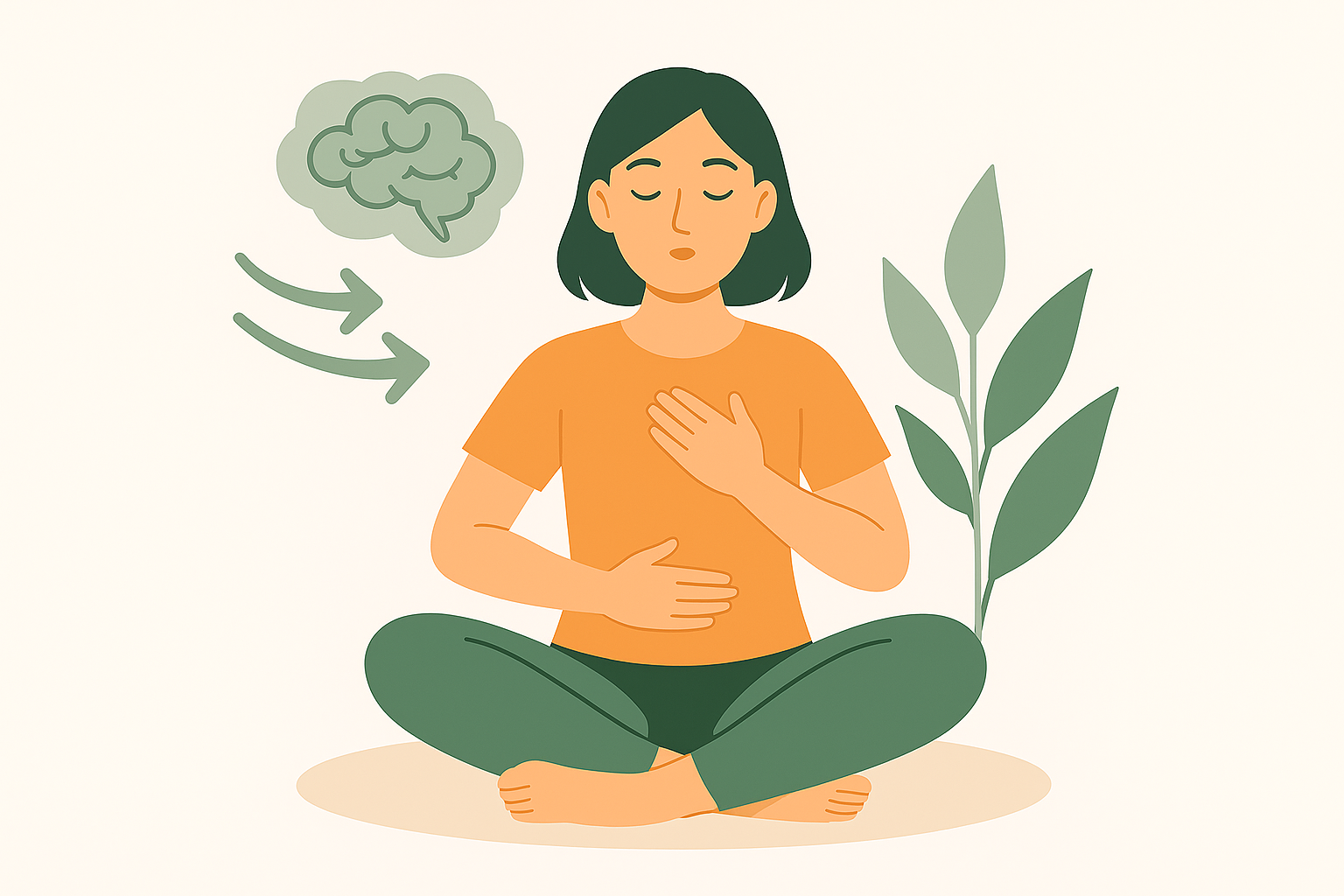
When the mind feels scattered, overwhelmed, or stuck in a loop of anxious thoughts, one of the most effective tools for regaining stability is already with you—your breath. Research from Harvard Medical School, the American Psychological Association, the National Institutes of Health, and Stanford University shows that intentional breathing directly influences brain activity, emotional regulation, and the nervous system.
Using breath to anchor the mind is not about controlling thoughts or forcing calm. Instead, it is about giving the brain a steady point of focus—something rhythmic, physical, and reliable—that gently pulls attention out of mental noise and back into the present moment.
If you are exploring mindfulness from the ground up, you may also find this helpful:
What Is Mindfulness and How to Start?
Why the Breath Is Such a Powerful Anchor
The breath is unique because it operates both automatically and consciously. You breathe without thinking, yet you can also slow, deepen, or observe your breath at any time. This dual control makes breathing one of the most effective bridges between the conscious and unconscious nervous system.
Harvard research explains that slow, intentional breathing activates the parasympathetic nervous system—the part responsible for rest, recovery, and emotional regulation. When this system turns on, heart rate slows, stress hormones decrease, and the mind naturally becomes quieter.
In contrast, shallow or rapid breathing activates the sympathetic nervous system, reinforcing stress and mental agitation.
The Mind–Breath Connection Explained by Science
Stanford neuroscience research shows that breathing patterns directly affect neural circuits involved in attention, emotion, and stress response. Specific neurons in the brainstem link breathing rhythms to areas of the brain responsible for focus and emotional balance.
This means:
- when breathing is rushed, the mind becomes restless
- when breathing is shallow, anxiety increases
- when breathing slows, the mind settles
- when breathing becomes steady, attention stabilizes
Using breath as an anchor works because it aligns the body and brain toward the same calm rhythm.
What It Means to “Anchor” the Mind
An anchor is something steady that keeps a ship from drifting. In mindfulness practice, an anchor is a focal point that prevents the mind from being pulled endlessly by thoughts, worries, and distractions.
The breath works as an anchor because:
- it is always present
- it has a natural rhythm
- it provides physical sensation
- it does not require imagination or belief
Rather than trying to “stop thinking,” breath awareness gives the mind a gentle task—returning attention again and again.
How Breath Awareness Calms Mental Overload
The APA reports that rumination and overthinking are linked to increased default mode network (DMN) activity in the brain. This network becomes overactive when the mind is idle or stressed.
Breath-focused attention reduces DMN activity by engaging present-moment awareness. Each time attention returns to the breath, the brain shifts out of mental replay and into sensory experience.
If overthinking is a frequent challenge, you may also find this useful:
The Psychology of Overthinking — And How to Manage It
Simple Ways to Use Breath as an Anchor
You do not need complex techniques to benefit from breath anchoring. Even simple awareness can create measurable effects.
1. Noticing the Natural Breath
Sit comfortably and notice where you feel the breath most clearly—your nostrils, chest, or abdomen. There is no need to change the breath.
Your only task is to notice:
- the inhale
- the exhale
- the pause between them
Each time the mind wanders, gently return attention to the breath.
2. Counting the Breath
Breath counting adds structure, which can be helpful for busy minds.
For example:
- inhale → count “one”
- exhale → count “two”
- continue up to ten, then restart
This keeps the mind engaged without strain.
3. Lengthening the Exhale
NIH research shows that a longer exhale signals safety to the nervous system.
Try:
- inhale for 4 seconds
- exhale for 6 seconds
This technique is especially effective for calming anxiety.
For more anxiety-focused methods, see:
Breathing Patterns to Calm an Anxious Mind
Using Breath During Stressful Moments
Breath anchoring is not limited to formal meditation. It can be used in real-life situations:
- before an important conversation
- during moments of frustration
- while waiting or feeling impatient
- when emotions feel overwhelming
Even three slow breaths can interrupt stress patterns and restore clarity.
Breath and Emotional Regulation
Emotions are physical experiences as much as mental ones. When emotions rise, breathing often becomes shallow or irregular.
By consciously slowing the breath, you send calming signals to the brain. This helps create a pause between emotion and reaction.
For learning how to respond instead of react, explore:
How to Respond Instead of React
Breath as an Anchor During Meditation
In meditation practice, the breath is one of the most commonly used anchors across traditions.
Benefits include:
- improved focus
- reduced mental chatter
- greater emotional awareness
- increased patience
Whether meditation is guided or silent, breath awareness remains central.
You may also enjoy:
Guided vs. Silent Meditation: Which Is Best?
Common Challenges When Using Breath Awareness
It is normal to encounter difficulties when first practicing breath anchoring.
- “My mind won’t stop thinking” — this is normal; returning attention is the practice.
- “I feel restless” — start with shorter sessions.
- “Breathing feels forced” — allow the breath to be natural.
- “I get distracted” — distraction is part of training attention.
There is no failure in breath awareness—only practice.
Breath and Mental Clarity
Consistent breath-focused practice improves clarity by reducing cognitive overload. When the nervous system is regulated, the brain processes information more efficiently.
This is why breath awareness is often included in morning routines for focus and productivity.
Related reading:
Mental Clarity Morning Routine
Using Breath to Improve Focus
Stanford research shows that breath awareness improves sustained attention by stabilizing neural oscillations related to focus.
A simple focus reset:
- pause work
- take five slow breaths
- return attention to the task
This technique is especially useful during long work sessions.
For productivity support, see:
How to Design a Distraction-Free Work Day
Breath Awareness and Sleep
Breath anchoring is also effective before sleep. Slower breathing lowers heart rate and prepares the body for rest.
Valerian, sound, and sleep routines work even better when paired with breath awareness.
Related reading:
Sleep Hygiene Tips for a More Restful Night
How Often Should You Practice?
Consistency matters more than duration. Even one to five minutes daily can create noticeable benefits over time.
You can practice:
- first thing in the morning
- during breaks
- before bed
- whenever stress arises
The breath is always available.
Final Thoughts
Using breath to anchor the mind is one of the simplest yet most powerful mental tools available. It does not require special equipment, long sessions, or perfect focus—only gentle attention.
By returning to the breath, you return to the present moment. Over time, this practice builds calm, clarity, and emotional balance, not by force, but by alignment with how the nervous system naturally works.
The breath does not eliminate thoughts—it teaches you not to be carried away by them.
More mindfulness resources from MindBloomDaily:
Daily Mindfulness Prompts
Body Scan Meditation Explained