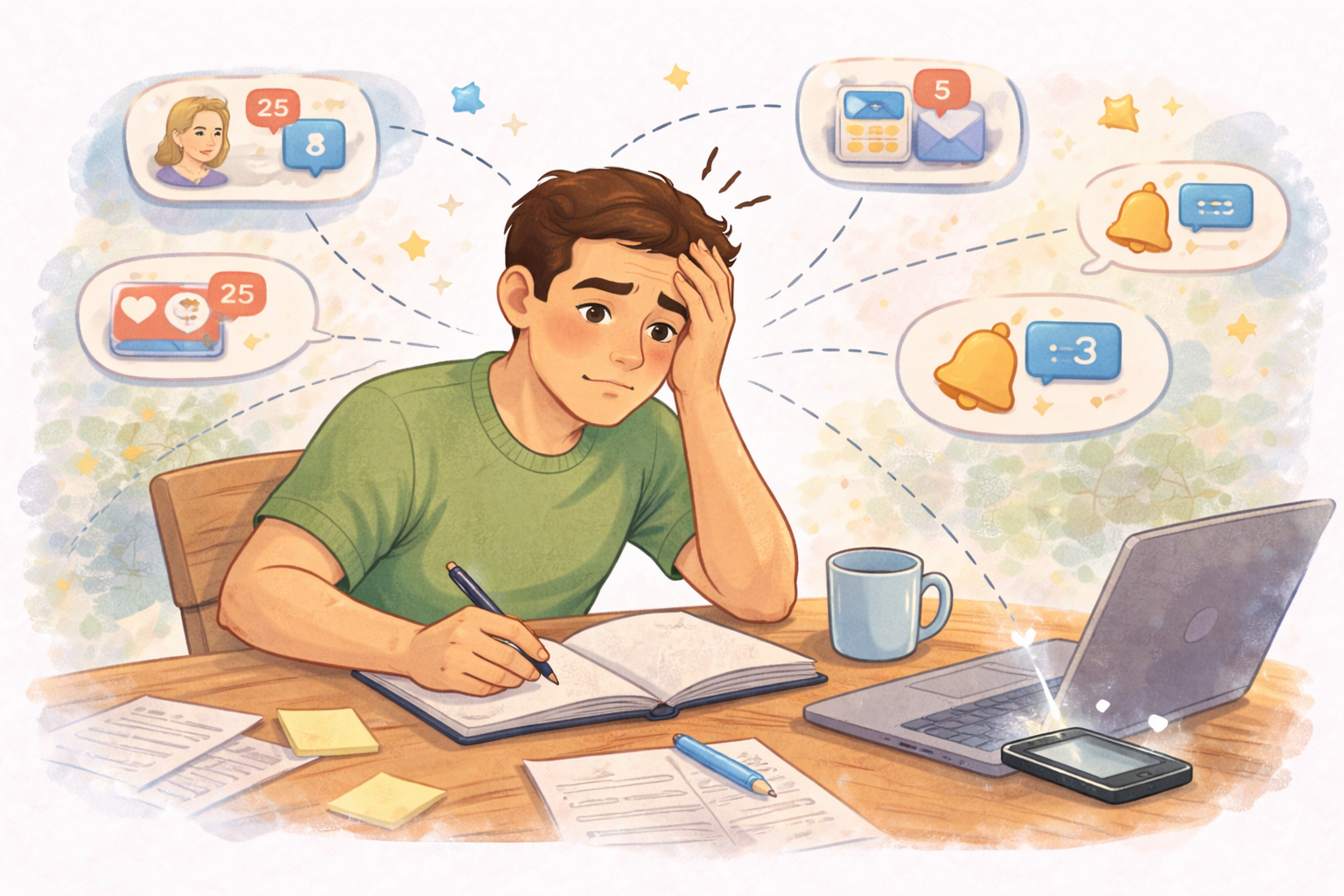
Notifications were designed to keep people informed and connected. Over time, they have become one of the most powerful disruptors of focus. From message alerts and app badges to email pings and system reminders, notifications constantly interrupt attention—even when we do not consciously engage with them. Research from Harvard Medical School, the American Psychological Association, the National Institutes of Health, and Stanford University shows that frequent interruptions fragment attention, increase stress, and reduce cognitive performance.
Even brief notifications can pull the brain out of deep focus, creating a cycle of constant mental resetting. Understanding how notifications affect attention is essential for protecting mental clarity and productivity.
If you’re exploring healthier digital habits, you may also find this helpful:
Creating a Digital Curfew
What Does “Fragmented Focus” Mean?
Fragmented focus occurs when attention is repeatedly interrupted, preventing sustained concentration.
Instead of engaging deeply with a task, the brain shifts rapidly between stimuli.
Stanford research shows that frequent task-switching reduces efficiency and increases mental fatigue—even when interruptions seem minor.
Notifications as Attention Hijackers
Notifications act as external cues that demand attention.
They trigger the brain’s orienting response—a survival mechanism that prioritizes new information.
This response evolved to detect threats, not manage modern digital input.
As a result, even silent notifications pull cognitive resources away from the current task.
The Hidden Cost of “Just a Quick Check”
Many people believe checking a notification takes only seconds.
However, Harvard research shows that after an interruption, the brain can take several minutes to fully regain focus.
This phenomenon is known as attention residue.
Each interruption leaves a trace of mental engagement behind.
How Notifications Increase Cognitive Load
Cognitive load refers to how much mental effort the brain is using.
Notifications add unnecessary load by forcing the brain to evaluate relevance.
Even when ignored, the brain processes the alert.
NIH-supported studies show that chronic cognitive overload reduces working memory and decision-making capacity.
Why Notifications Feel Urgent
Notifications are designed to feel important.
Badges, sounds, and vibrations activate dopamine-driven anticipation.
This creates a sense of urgency—even when the content is trivial.
Learn more about this mechanism here:
The Dopamine Loop: Understanding the Scroll Addiction
Notifications and Stress Response
Each interruption activates a mild stress response.
Over time, repeated alerts keep the nervous system in a semi-alert state.
APA research links constant digital interruptions to increased cortisol levels and emotional exhaustion.
This makes sustained calm focus harder to maintain.
Multitasking Is a Myth
Notifications encourage multitasking.
However, neuroscience shows the brain does not truly multitask—it switches rapidly between tasks.
Each switch reduces accuracy and increases fatigue.
Stanford researchers found that heavy multitaskers perform worse on attention tests.
The Impact on Deep Work
Deep work requires uninterrupted concentration.
Notifications break this state before it fully forms.
This affects creativity, learning, and problem-solving.
Related reading:
The Power of Single-Tasking Over Multitasking
Notifications and Memory Formation
Focus is required for memory consolidation.
Interruptions disrupt the brain’s ability to encode information.
This leads to shallow learning and poor retention.
NIH research links distraction to reduced hippocampal activity.
Why Some Notifications Are Harder to Ignore
Social notifications trigger emotional relevance.
Messages, likes, and mentions activate social bonding systems.
This makes them especially disruptive.
Social alerts often feel personal, increasing attentional pull.
Notification Fatigue and Mental Exhaustion
Over time, constant alerts lead to notification fatigue.
This includes:
- reduced motivation
- irritability
- mental fog
- difficulty prioritizing
Paradoxically, more alerts lead to less responsiveness.
How Notifications Affect Emotional Regulation
Interrupted attention weakens emotional regulation.
Sleep deprivation and digital overload increase emotional reactivity.
This can spill into work and relationships.
Related reading:
How to Respond Instead of React
The Illusion of Productivity
Responding quickly to notifications can feel productive.
However, constant responsiveness reduces meaningful output.
Harvard research shows that productivity depends on sustained focus, not reaction speed.
How Notifications Impact Creativity
Creative thinking requires mental wandering and depth.
Frequent interruptions prevent ideas from fully developing.
Stanford studies link uninterrupted time to higher creative insight.
Creating Notification Boundaries
Not all notifications deserve equal attention.
Effective strategies include:
- turning off nonessential alerts
- batch-checking messages
- using focus modes
Boundaries reduce cognitive strain.
Notification Design vs Human Biology
Most apps are optimized for engagement, not wellbeing.
Human attention is limited.
Reducing alerts aligns technology with cognitive reality.
Mindfulness and Attention Recovery
Mindfulness strengthens awareness of attention shifts.
Stanford research shows mindfulness improves attentional control.
It helps notice distractions without acting on them.
Learn more here:
What Is Mindfulness and How to Start?
Notifications and Sleep Disruption
Nighttime alerts interfere with sleep onset.
Even anticipation of notifications disrupts rest.
Sleep loss compounds focus fragmentation.
Related reading:
The Impact of Screen Time on Sleep Quality
Reclaiming Control Over Attention
Attention improves when interruptions decrease.
Small changes yield noticeable benefits.
Control returns through intentional design.
Common Myths About Notifications
- Myth: Ignoring alerts causes missed opportunities
Reality: Most alerts are non-urgent - Myth: Fast replies equal efficiency
Reality: Depth produces value - Myth: You can adapt to interruptions
Reality: The brain pays a cost
When Notification Control Feels Difficult
Habitual checking is often stress-driven.
Reducing overall stress makes boundaries easier.
Supportive routines help break cycles.
Final Thoughts
Notifications fragment focus not because of personal weakness, but because they are designed to capture attention.
Each interruption carries a cognitive cost.
By reducing unnecessary alerts, attention becomes steadier, work becomes deeper, and mental fatigue decreases.
Focus is not about doing more—it is about protecting the space to do what matters.
More digital wellness insights from MindBloomDaily:
Clean Your Digital Space, Clear Your Mind
How to Design a Distraction-Free Work Day