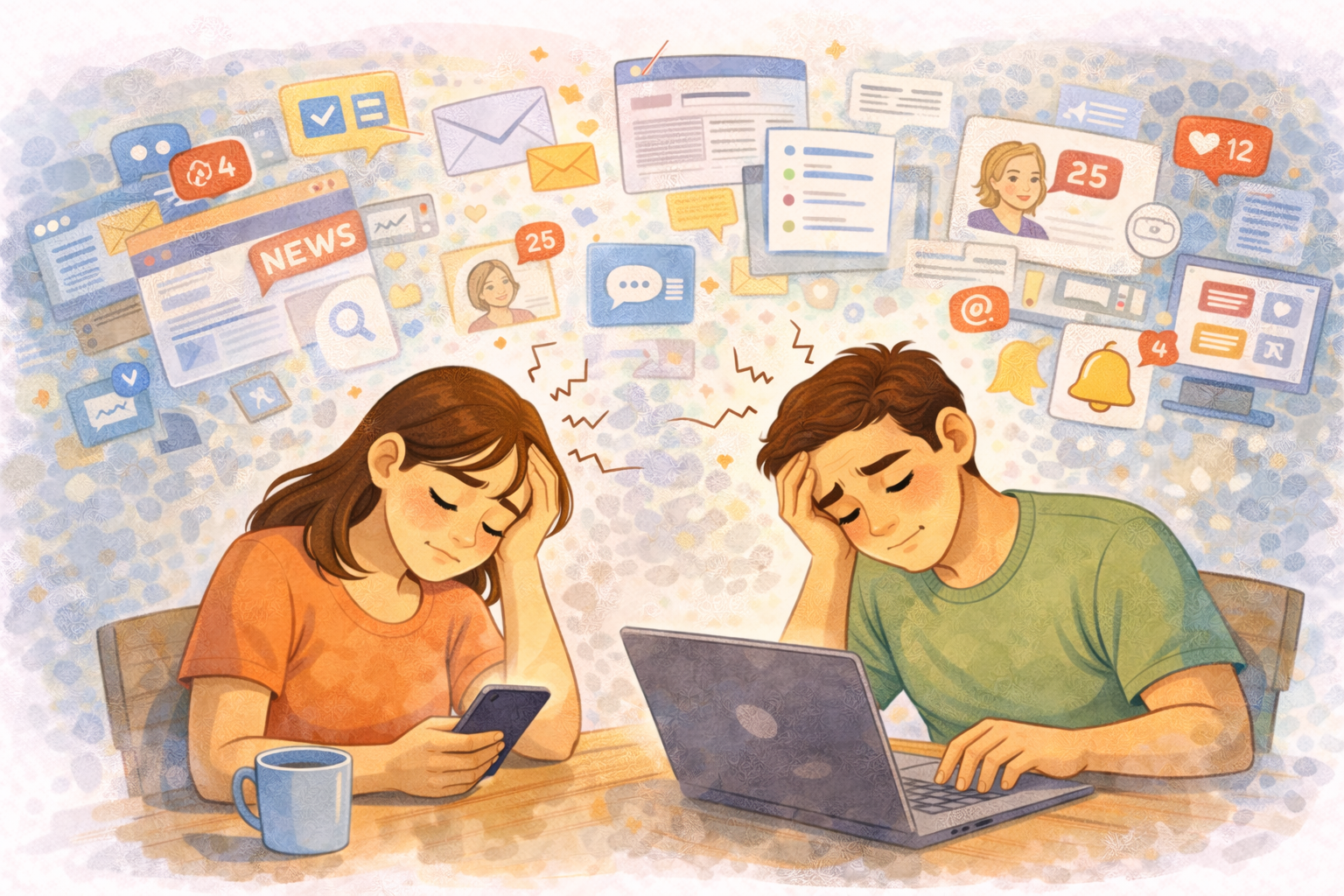
The internet has made information, communication, and entertainment instantly accessible. Yet constant connectivity comes with an often-overlooked cost: online overwhelm. When digital input exceeds the brain’s ability to process it, mental fatigue sets in. Research from Harvard Medical School, the American Psychological Association, the National Institutes of Health, and Stanford University shows that sustained digital overload impairs attention, emotional regulation, and overall mental wellbeing.
Online overwhelm does not arrive suddenly. It builds quietly through endless tabs, notifications, scrolling, and information consumption. Over time, the mind becomes tired—not from effort, but from excess.
If you’re exploring ways to protect your mental energy, you may also find this helpful:
Clean Your Digital Space, Clear Your Mind
What Is Online Overwhelm?
Online overwhelm occurs when digital input surpasses the brain’s processing capacity.
This may involve:
- constant notifications
- excessive screen time
- information overload
- frequent task-switching
- pressure to stay connected
The result is mental fatigue rather than productivity.
Understanding Mental Fatigue
Mental fatigue is a state of cognitive exhaustion.
It affects attention, memory, motivation, and emotional control.
Harvard research shows that mental fatigue reduces the brain’s ability to filter irrelevant information.
This makes everything feel harder.
Why the Brain Tires From Digital Input
The brain evolved to process limited, meaningful information.
Digital environments flood it with rapid, fragmented input.
NIH-supported studies show that constant stimulation depletes cognitive resources.
Recovery requires periods of low input.
Information Overload and Cognitive Strain
Information overload occurs when the volume of information exceeds processing ability.
This forces the brain to make continuous filtering decisions.
Each decision consumes mental energy.
APA research links information overload to stress and reduced decision quality.
The Role of Notifications in Mental Fatigue
Notifications fragment attention.
Each alert pulls cognitive resources away from the current task.
Even ignored notifications increase mental load.
Related reading:
How Notifications Fragment Your Focus
Why Multitasking Worsens Online Overwhelm
Digital environments encourage multitasking.
However, the brain switches rather than multitasks.
Stanford research shows frequent switching increases fatigue and reduces accuracy.
Single-tasking protects mental energy.
Related reading:
The Power of Single-Tasking Over Multitasking
Online Overwhelm and Emotional Exhaustion
Mental fatigue affects emotions.
People experiencing online overwhelm often report:
- irritability
- low motivation
- difficulty concentrating
- emotional numbness
APA research shows cognitive exhaustion reduces emotional regulation capacity.
The Dopamine Loop and Digital Fatigue
Many digital platforms rely on variable rewards.
This keeps users engaged while draining attention.
Repeated dopamine activation without fulfillment contributes to exhaustion.
Learn more here:
The Dopamine Loop: Understanding the Scroll Addiction
Online Overwhelm and Focus Decline
Sustained digital overload weakens focus.
Attention becomes scattered.
Deep concentration feels increasingly difficult.
Stanford studies link digital overload to reduced attentional control.
Sleep Disruption and Mental Fatigue
Excessive screen time interferes with sleep.
Poor sleep compounds mental fatigue.
NIH research links sleep deprivation to reduced cognitive performance.
Related reading:
The Impact of Screen Time on Sleep Quality
Signs You’re Experiencing Online Overwhelm
- difficulty finishing tasks
- frequent checking without purpose
- mental fog
- reduced creativity
- feeling mentally “fried”
Recognizing these signs is the first step toward recovery.
Why Constant Connectivity Is Draining
The expectation of constant availability increases cognitive load.
The brain never fully rests.
Boundaries restore recovery periods.
Reducing Online Overwhelm Gently
Recovery does not require abandoning technology.
Effective strategies include:
- limiting notifications
- batching online tasks
- creating screen-free blocks
Small changes accumulate.
The Importance of Digital Downtime
Downtime allows the brain to reset.
Stanford research shows rest supports creativity and problem-solving.
Unstructured time is essential.
Mindfulness and Mental Recovery
Mindfulness helps disengage from constant stimulation.
It strengthens awareness of mental fatigue.
Learn more here:
What Is Mindfulness and How to Start?
Creating Boundaries to Protect Mental Energy
Boundaries reduce cognitive strain.
This may include digital curfews or focused work periods.
Related reading:
Creating a Digital Curfew
Why Mental Fatigue Is Not Laziness
Mental fatigue reflects depleted cognitive resources.
Rest is a biological need, not a weakness.
Self-compassion supports recovery.
Rebuilding Focus After Overload
Focus returns gradually.
Low-stimulation activities support recovery.
Examples include walking, journaling, or deep reading.
Related reading:
The Case for Analog Journals
Long-Term Effects of Unmanaged Online Overwhelm
Chronic digital overload increases burnout risk.
It affects motivation, mood, and performance.
Early intervention protects wellbeing.
Common Myths About Mental Fatigue
- Myth: More input equals productivity
Reality: Focus thrives with limits - Myth: You can adapt indefinitely
Reality: The brain needs recovery - Myth: Mental fatigue is weakness
Reality: It is physiological
Making Mental Recovery a Priority
Recovery is part of performance.
Protecting mental energy improves clarity, creativity, and emotional balance.
Intentional digital use supports long-term wellbeing.
Final Thoughts
Online overwhelm and mental fatigue are not personal failures—they are natural responses to excessive stimulation.
By recognizing overload, setting boundaries, and allowing the brain to rest, clarity can return.
Mental energy is finite. Protecting it is essential for a balanced, focused life.
More digital wellness resources from MindBloomDaily:
Reducing Screen Time Without Feeling Deprived
How to Design a Distraction-Free Work Day