Sleep is not a single, uniform state of rest. It is a dynamic biological process made up of repeating cycles that support physical restoration, emotional balance, memory consolidation, and cognitive clarity. Understanding how sleep cycles work helps explain why some nights feel deeply restorative while others leave the mind foggy and unfocused. Research from Harvard Health, the National Institutes of Health, the Sleep Foundation, and the American Psychological Association shows that healthy sleep depends not just on duration, but on the quality and structure of sleep cycles.
When sleep cycles are disrupted, even a full night in bed may not result in true mental or physical recovery.
If you’re working to improve rest and clarity, you may also find this helpful:
Sleep Hygiene Tips for a More Restful Night
What Are Sleep Cycles?
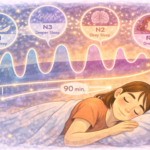
A sleep cycle is a progression through different stages of sleep.
Each cycle lasts approximately 90 to 110 minutes.
Most adults experience four to six sleep cycles per night.
Each cycle includes both non-REM and REM sleep.
The Two Main Types of Sleep
Sleep is divided into two broad categories:
- Non-REM sleep
- REM sleep
Both are essential.
They serve different but complementary functions.
Non-REM Sleep: The Foundation of Restoration
Non-REM sleep makes up about 75–80% of total sleep time.
It consists of three distinct stages.
Stage 1: Light Sleep
Stage 1 is the transition between wakefulness and sleep.
Muscle activity slows.
Awareness of the environment decreases.
This stage typically lasts only a few minutes.
Stage 2: True Sleep Begins
Stage 2 is characterized by slower brain waves and reduced heart rate.
Body temperature begins to drop.
Sleep spindles—brief bursts of brain activity—appear.
Harvard research links sleep spindles to memory consolidation.
Stage 3: Deep Sleep
Stage 3 is also known as slow-wave or deep sleep.
This is the most physically restorative stage.
The body repairs tissue, strengthens immunity, and releases growth hormone.
NIH research shows deep sleep is essential for physical recovery.
Why Deep Sleep Matters
Without sufficient deep sleep, people may feel physically exhausted.
Chronic lack of deep sleep is linked to weakened immunity.
It also affects emotional regulation.
REM Sleep: The Brain’s Processing Stage
REM stands for Rapid Eye Movement.
This stage is associated with vivid dreaming.
Brain activity during REM resembles wakefulness.
Muscles are temporarily paralyzed.
The Role of REM Sleep
REM sleep supports:
- memory consolidation
- emotional processing
- learning and creativity
APA research shows REM sleep plays a key role in emotional resilience.
How Sleep Cycles Progress Through the Night
Early sleep cycles contain more deep sleep.
Later cycles contain more REM sleep.
This balance is intentional.
Both types are needed for full recovery.
Why Waking at the Wrong Time Feels Awful
Waking during deep sleep causes sleep inertia.
This leads to grogginess and impaired focus.
Waking between cycles feels more refreshing.
This explains why sleep timing matters as much as duration.
Circadian Rhythm and Sleep Cycles
The circadian rhythm is the body’s internal clock.
It regulates sleep-wake timing.
Light exposure strongly influences circadian rhythms.
Disruptions affect sleep cycle quality.
Related reading:
Natural Light and Your Mental Health
How Stress Affects Sleep Cycles
Stress activates the nervous system.
This interferes with deep and REM sleep.
NIH research links chronic stress to fragmented sleep cycles.
Relaxation before bed supports cycle integrity.
Sleep Cycles and Mental Clarity
Healthy sleep cycles support attention and focus.
Disrupted cycles contribute to brain fog.
Related reading:
Brain Fog Explained: Causes & Relief
The Impact of Screen Time on Sleep Cycles
Blue light suppresses melatonin.
This delays sleep onset.
Delayed sleep shifts cycle timing.
Related reading:
The Impact of Screen Time on Sleep Quality
Alcohol and Sleep Architecture
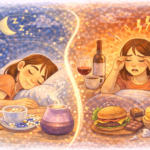
Alcohol reduces REM sleep.
It fragments sleep later in the night.
This leads to poorer emotional recovery.
Napping and Sleep Cycles
Short naps usually involve light sleep.
Long naps may disrupt nighttime cycles.
Related reading:
Napping: Helpful or Harmful?
How Much Sleep Is Enough?
Most adults need 7–9 hours of sleep.
This allows enough time for multiple full cycles.
Short sleep limits REM and deep sleep.
Consistency and Sleep Cycles
Going to bed at the same time stabilizes cycles.
Irregular schedules confuse the circadian rhythm.
Consistency improves sleep quality.
Supporting Healthy Sleep Cycles
Evidence-based strategies include:
- consistent sleep and wake times
- limiting evening screen exposure
- creating a dark, cool sleep environment
- avoiding heavy meals late at night
Related reading:
How to Create a Sleep-Inducing Environment
Common Myths About Sleep Cycles
- Myth: All sleep is equal
Reality: Different stages serve different functions - Myth: More time in bed means better sleep
Reality: Quality matters more - Myth: REM sleep is optional
Reality: It is essential for mental health
When Sleep Cycles Are Consistently Disrupted
Persistent sleep disruption may signal sleep disorders.
NIH recommends professional evaluation if problems persist.
Early intervention improves outcomes.
Final Thoughts
Sleep cycles are the hidden architecture of rest.
They determine how refreshed, focused, and emotionally balanced you feel.
Understanding the science behind sleep cycles empowers better choices.
When sleep cycles are protected, the mind and body recover naturally.
Good sleep is not passive.
It is a carefully timed biological process worth supporting.
More sleep and restoration resources from MindBloomDaily:
Why You Might Be Struggling to Sleep
Benefits of a Fixed Sleep Schedule