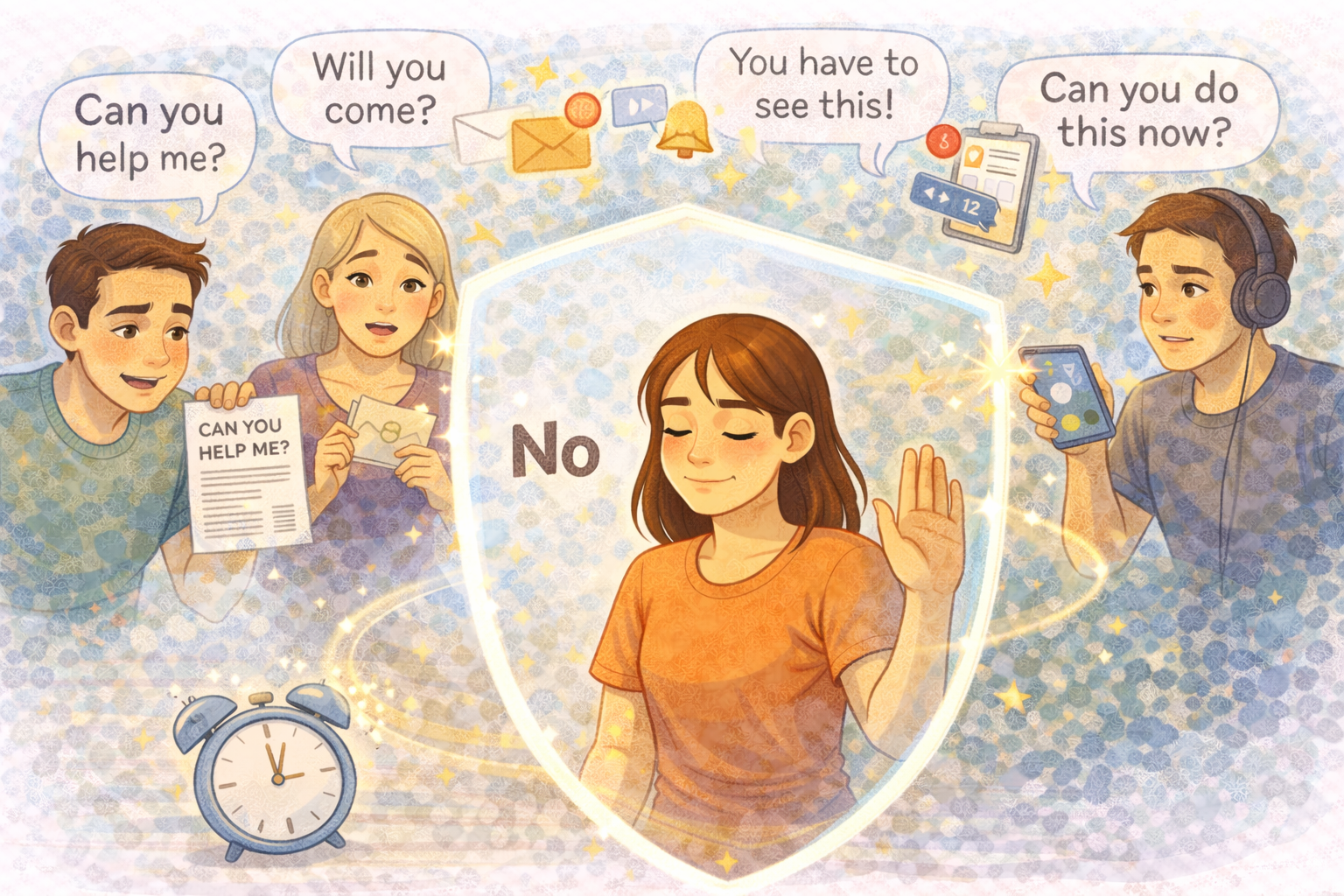
Saying “yes” often feels polite, responsible, or even necessary. Many people learn early on that being helpful and agreeable keeps relationships smooth. Yet over time, too many yeses can quietly drain emotional energy, increase stress, and disrupt inner peace. Research from Harvard Medical School, the American Psychological Association, the National Institutes of Health, and Stanford University shows that healthy boundaries are essential for emotional regulation, mental clarity, and long-term wellbeing.
Knowing when to say no is not about being selfish. It is about protecting the limited mental and emotional resources that allow you to show up fully where it truly matters.
If you are already exploring emotional balance, you may also find this helpful:
Building Emotional Resilience
Why Saying No Feels So Difficult
For many people, saying no triggers discomfort.
This discomfort often comes from:
- fear of disappointing others
- desire to be liked or accepted
- habitual people-pleasing
- belief that worth is tied to usefulness
APA research shows that chronic people-pleasing is linked to increased stress and emotional exhaustion.
The Hidden Cost of Always Saying Yes
Each yes consumes time, attention, and emotional energy.
When those resources are overstretched, the nervous system remains in a state of chronic stress.
NIH-supported studies link prolonged stress to anxiety, burnout, and reduced immune function.
Protecting peace requires limits.
What Does “Protecting Your Peace” Mean?
Protecting your peace means preserving emotional stability, mental clarity, and inner calm.
It involves making choices that support long-term wellbeing rather than short-term approval.
Peace is not avoidance—it is alignment.
Peace Requires Boundaries
Boundaries define where your responsibility ends and another person’s begins.
Harvard research shows that clear boundaries reduce emotional overload and improve relationship satisfaction.
Without boundaries, peace erodes gradually.
When Saying Yes Becomes Self-Betrayal
Saying yes becomes harmful when it contradicts your needs or values.
Signs include:
- resentment after agreeing
- constant fatigue
- loss of personal time
- feeling emotionally depleted
These signals indicate it may be time to say no.
When to Say No to Protect Your Peace
Knowing when to say no is a skill.
Common situations where saying no protects peace include:
- when requests exceed your capacity
- when commitments conflict with your values
- when interactions consistently drain you
- when rest or recovery is needed
Saying no in these moments prevents long-term harm.
Emotional Exhaustion as a Boundary Signal
Emotional exhaustion is not weakness.
It is feedback.
Stanford research shows that emotional depletion reduces cognitive performance and emotional regulation.
Listening to fatigue protects health.
Why Guilt Often Follows Saying No
Guilt often arises from learned expectations.
Many people confuse kindness with self-sacrifice.
APA research shows that guilt diminishes as boundaries become normalized.
Discomfort fades with practice.
Saying No Without Over-Explaining
Over-explaining is often an attempt to manage others’ reactions.
Clear, respectful no’s are enough.
Examples include:
- “I’m not able to take this on right now.”
- “That doesn’t work for me.”
- “I need to prioritize something else.”
Clarity builds respect.
The Difference Between Assertive and Aggressive No’s
Assertive communication is calm and direct.
Aggressive communication is reactive or dismissive.
Assertiveness protects peace without damaging relationships.
Related reading:
Assertive vs. Aggressive Communication
How Saying No Improves Mental Health
Boundaries reduce cognitive overload.
Harvard research links assertive boundary-setting to lower anxiety and better emotional balance.
Saying no creates space for rest, focus, and reflection.
Saying No in Relationships
Healthy relationships respect limits.
Saying no clarifies expectations.
It prevents resentment from building silently.
Related reading:
Trust Building Habits
Saying No at Work
Workplace boundaries protect long-term performance.
Overcommitment leads to burnout.
APA research shows that employees with clear boundaries report higher job satisfaction.
Sustainable productivity requires restraint.
Protecting Peace in Digital Spaces
Digital demands can be constant.
Saying no to notifications, endless scrolling, or immediate replies preserves mental energy.
Related reading:
Protecting Your Mental Energy Online
Boundaries and Self-Respect
Every time you honor your limits, you reinforce self-trust.
Self-respect grows through consistent boundary-setting.
Peace follows alignment.
When People React Poorly to Your No
Not everyone will welcome your boundaries.
Discomfort in others does not mean you are wrong.
Stanford research shows that boundary resistance often reflects unmet expectations, not failure.
Letting Go of the Need to Be Liked
Seeking approval is exhausting.
Inner peace requires internal validation.
Authenticity reduces emotional strain.
Practicing Saying No
Boundary-setting improves with repetition.
Start with low-stakes situations.
Confidence builds gradually.
Replacing Guilt With Compassion
Compassion applies to yourself as well.
NIH research links self-compassion to improved emotional resilience.
Gentleness supports change.
Peace as a Daily Practice
Protecting peace is not a one-time decision.
It is a daily practice of awareness and choice.
Each no creates room for a meaningful yes.
Final Thoughts
When to say no is ultimately about knowing yourself.
Your energy, time, and emotional wellbeing are finite.
Saying no does not make you difficult—it makes you honest.
Peace grows when boundaries are honored.
You do not need permission to protect your peace.
More emotional wellbeing resources from MindBloomDaily:
How to Respond Instead of React
Practicing Self-Compassion Daily